
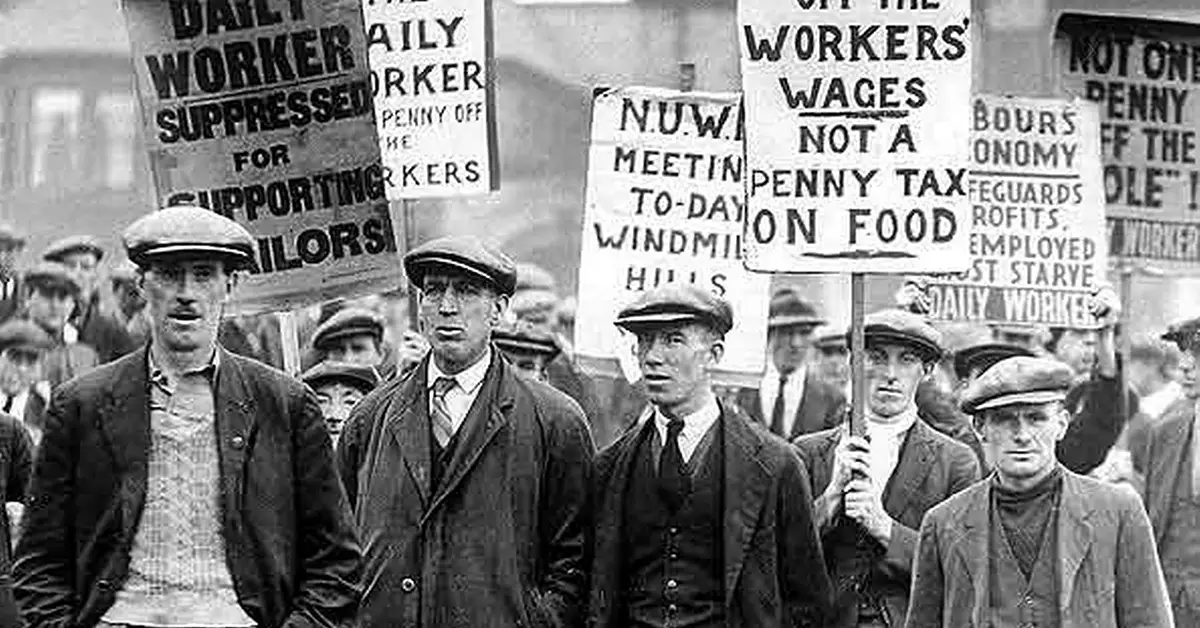
We study the great moments of past class struggle not merely to recall the heroism of our forebears but to draw out the lessons they hold for today. It is in that spirit that Workers Power has expanded and re-issued this pamphlet on the 1926 General Strike for its centenary.
This pamphlet examines the reasons for the strike’s defeat—though that takes nothing away from the courage and determination of the rank and file. In Fife and Glasgow, Liverpool, Newcastle, London and the South Wales valleys, elements of dual power existed and could have been developed. A pre-revolutionary situation gripped Britain. The only thing that prevented it maturing was the non-revolutionary policy of the trade unions, the Labour Party and the Communist Party. So while commemorating the working class in struggle, we must also learn from its failure.
The first lesson is that the trade unions—instruments to raise wages, defend conditions and win reforms—are also a basis for socialist revolution in Britain. But on their own they cannot lead that revolution while the permanent officialdom, the bureaucracy, retains control of them. This remains true today, despite the changed composition of the class. The unions still represent only a minority of workers, so, as the revolutionaries of the 1920s saw, we must expand them by organising the unorganised, the downtrodden and the unemployed. At the same time we reject the notion, popularised by the likes of Unite’s Sharon Graham, that the unions should remain clear of politics. Socialists must fight ‘pure and simple trade unionism’ as an ideology—and this work begins today, not at the last minute.
The second lesson is that the idea Britain does not face the question of revolution—that a ‘democracy’ immunises workers against revolutionary ideas s false. Just two years after the first Labour government, millions struck against an elected Tory government and hundreds of thousands fought the forces of the state. The ruling class declared that class-wide solidarity with a million locked-out miners was a challenge to the constitution and had to be smashed. A section of the trade union and Labour leaders agreed with them — and held power in our movement at the decisive moment. Similar conditions recurred in the 1970s and 1980s, and on a smaller scale in the two-million-strong public-sector strike of 30 November 2011, each sold out by the union leaders.
The third lesson is that in the epoch of imperialism an apparent trade dispute can escalate, by its own dynamic, into a struggle for power. A general strike that is more than a one-day demonstration poses, as Trotsky said, ‘who shall be master in the house’. The Miners’ Strike of 1984–85 posed this too: not a trade dispute but a planned government assault, Thatcher’s as Baldwin’s had been, aimed at breaking the working class and its vanguard. Only mass solidarity action — a de facto general strike by key unions — could have beaten her. The failure to fight for it was paid for by the whole class. To realise this potential, workers must build councils of action and workers’ defence corps. That is why, in every significant class-wide struggle — most recently the 2022–23 strike wave — communists must raise the necessity of such organisations.
The fourth lesson is that militants who trust the left-talking wing of the bureaucracy must maintain their independence and build the nucleus of an alternative leadership, answerable to the democratic decisions of the members. Most left groupings in the unions today are Broad Lefts, focused on electing and protecting left officials. This is futile, as the capitulations of figures far more militant than today’s leaders—Scanlon and Jones in the 1978–79 Winter of Discontent, the betrayals of 1984–85—have shown. We need instead a rank-and-file movement independent of every wing of the bureaucracy. We support left officials against the right where they back democracy and militancy, but the rank and file must set their own goals and methods, including the fight to abolish the wages system: socialism must be written on its banners. As Trotsky put it, this means the ‘perpetual, systematic, inflexible, untiring and irreconcilable unmasking of the quasi-left leaders of every hue’.
The fifth and final lesson is the necessity of a revolutionary party. Only such a party, rooted in the class and influential in its combative organisations, can guide workers through the twists of struggle and build a bridge from reformist to revolutionary consciousness. Trotsky knew the young CPGB might not lead the workers to victory at the first attempt, but that an inconclusive outcome would afford it later opportunities—provided it held a correct line. As he wrote on 6 May 1926: ‘The results of the strike… will be the more significant the more resolutely the revolutionary force of the masses sweeps away the barriers erected by the counter-revolutionary leadership.’ This stood in stark contrast to Zinoviev and Stalin, who gave up on the CPGB and sought a short-cut through the trade union lefts of the Anglo-Russian Committee.
This matters today, when it is fashionable to dismiss the ‘sects’ — small, programmatically based groups. The antics of the SWP and Socialist Party have alienated many, but the need for revolutionary clarity cannot be dismissed: you don’t reject the need for a bicycle because there are two broken bikes in the shed. The decisive force in 1926 was not the 50,000-strong Independent Labour Party but the CPGB, one-twentieth its size, with a democratic-centralist structure, a correct programme (for a time) and, through the National Minority Movement, influence among the most militant workers. That programme needs refining — even mid-struggle — but the idea we can do without one must be rejected outright.
A revolutionary party must also embody its programme in strategy and tactics for the concrete struggle: a correct assessment of the political issues, of the existing leadership, and of the forces with which a united front can be built. There is no party in Britain today capable of providing an alternative to the bureaucrats, right or left. That remains to be built, on a programme linking today’s struggles to the revolutionary abolition of capitalism. That is why we urge workers, women and youth to read this pamphlet, discuss it with Workers Power—and, if you agree with us, to join us.


